
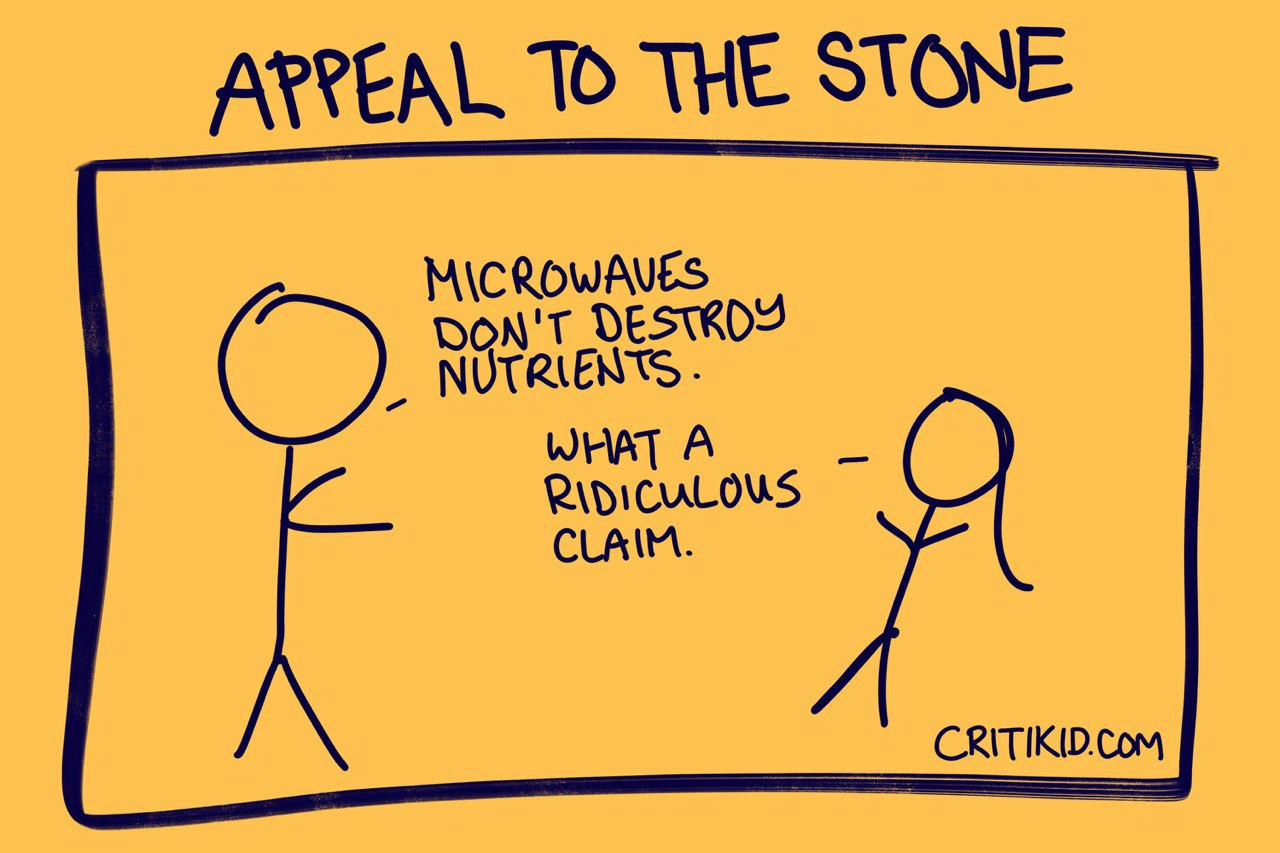
Appeal to the Stone
“Screen time effects depend on context.”
“That’s ridiculous.”
You commit the appeal to the stone fallacy when you dismiss a claim as absurd without giving any reason or evidence. It can show up like “That’s nonsense,” “Be serious,” or “That’s obviously false.” Often, people say these things because they don’t want to engage in a debate. That’s fine, and not necessarily a fallacy—we don’t owe everyone who makes a claim a full discussion. But we shouldn’t pretend these statements are rebuttals; they’re just conversation-enders.
This fallacy often appears as “You’re being pedantic,” “You’re splitting hairs,” or “You’re arguing semantics.” Sometimes a person does get stuck on irrelevant details; but at other times, those “hairs” are crucial details to address. For example, in equivocation we saw this example: “Plate tectonics is just a theory. I have my own theories.” Someone might reply, “In science, ‘theory’ means a well-supported explanation.” If the first person brushes this off by saying, “Don’t be pedantic,” they’ve committed a second logical fallacy: appeal to the stone.
Buy a printable version of this handbook.
Teach your kids about logical fallacies with Critikid's Fallacy Detectors.